

The building cannot be overinsulated, there is almost no upper limit to the thickness of the thermal insulation, except, of course, within the limits of reasonableness.
How thick should the thermal insulation board be? Energy calculations determine the thickness of the thermal insulation to be used, compared to which it cannot be less, but it can be more. Construction errors and inaccuracies that arise during construction can impair the effectiveness of the installed thermal insulation.
The building cannot be overinsulated, there is almost no upper limit to the thickness of the thermal insulation, of course, except for the limits of reasonableness. To determine the lower limits and minimums, we must take into account other economic circumstances in addition to the current energy requirements, which in the case of a given building is based on a complex approach to the optimal thickness.
When determining the thickness of the thermal insulation, it is assumed that the given building structure unit will be implemented according to plan and with appropriate accuracy and care. Unfavorable designs resulting from various construction inaccuracies and existing conditions in the case of renovations greatly influence the final determination of the thickness of the thermal insulation.
An example: facade thermal insulation of a panel building. It is almost common for the joint inaccuracy on panel facades to exceed the +/- 5 mm specified by the System Administrators in the Technical and Implementation Guidelines for Total Thermal Insulation Systems (THRs) of the Hungarian Construction Chemistry and Rendering Association (MÉVSZ). A frequently occurring WRONG practice during construction is that in order to compensate for larger deviations from the plane, they try to compensate for the differences in plane with the thickness of the adhesive used to attach the thermal insulation, often with a thickness of 2-4 cm. It is important to note that the relevant Guidelines maximize the adhesive thickness of the adhesive application at 1 cm! For the correct solution, the difference must be compensated for by changing the thickness of the thermal insulation boards by 1-1 centimeters (in addition to cording) in such a way that the adhesive thickness does not exceed 1 cm anywhere. Question: How thick should the thermal insulation board be? Energy calculations determine a thermal insulation thickness to be used, compared to which it cannot be less, but it can be more.
Where should the thickness of the thermal insulation be according to the calculation; in the place protruding from the general plane or in the place recessed from it?
There are two options:
1. The planned thickness is placed on the area that protrudes most from the facade plane and an increased thermal insulation thickness is placed on all surfaces that are further in.
2. The thickness range resulting from the deviation from the plane is determined by a weighted average calculation and, accordingly, slightly thinner thermal insulation must be placed on the protruding area, while thicker thermal insulation must be placed on the recessed surface units. If such solutions are not prepared, either the final, plastered plane will not be sufficiently even, or the energy calculation conditions will not be met, and this will have warranty, value-reducing, and mandatory repair implications.
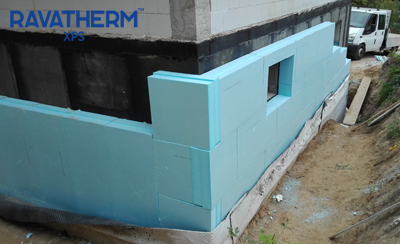
The use of XPS thermal insulation on facade walls is recommended mainly on the plinth or on thermal bridge structures. On these surfaces, the unevenness of the supporting base can cause the same problems as on panel walls. In the case of smaller plinth heights, even if the vertical differences are not significant, the horizontal ones are even more so, in which case the same correct leveling solution is used as on the aforementioned vertical panel walls. The extreme unevenness of the supporting base surfaces can be experienced not only on the walls, but also in floors and ceilings.

In such places, it is not advisable to operate with the thickness of the thermal insulation, but instead, the unevenness of the base should be eliminated, for example with a leveling screed, or simply with a base plaster drawn to the appropriate level with a lath.

From the perspective of return on investment, it can be stated that in the case of new construction, it is worth aiming for the highest possible energy rating. This is when the construction investment is most worthwhile, as the additional insulation will result in significant savings over the years of operation, and we can also postpone the need for major renovations later.
In renovation works, the evaluation can also be divided into two: 1. the subsequent thermal insulation is for energy purposes, or 2. the renovation is for the purpose of preserving the condition and ensuring appropriate comfort. By preserving the condition – in this case – we mean the elimination of unwanted condensation, thereby – among other things – eliminating mold growth. By ensuring comfort, we mean ensuring the appropriate feeling of warmth. (the difference in surface temperature from the internal air temperature should not be greater than +/– 2 oC; on the floor, internal wall surface, ceiling).
It is a common practice to calculate the payback period of more than 10 years, and it is not worth evaluating it from this perspective.
Since every case is different to a greater or lesser extent, it would not be wise to generalize without precise knowledge/definition of all the characteristics and environmental conditions of a given building structure unit. Instead, let’s review the most typical building parts with the minimum recommended thermal insulation thicknesses:
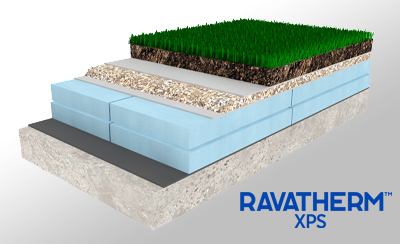
on flat roofs min. 22 cm, recommended: 28 cm
on pitched roofs min. 22 cm, recommended: 28 cm
in a floor lying on the ground. 10 cm, recommended: 16 cm
under building min. 10 cm, recommended: 16 cm in thermal bridges min. 8 cm, recommended: 12 cm
on plinths, basement walls min. 14 cm, recommended: 20 cm
on plinths, basement walls min. 14 cm, recommended: 20 cm
A hőszigetelés vastagságának meghatározása sok tényezőtől függ, amelyben mindenképpen megfelelő felkészültségű szakember(ek) bevonása ajánlott.
Leave a Reply