

The high-thickness RAVATHERM XPS extruded polystyrene foam thermal insulation is suitable for installation in green roofs or even mixed-use inverted flat roofs.
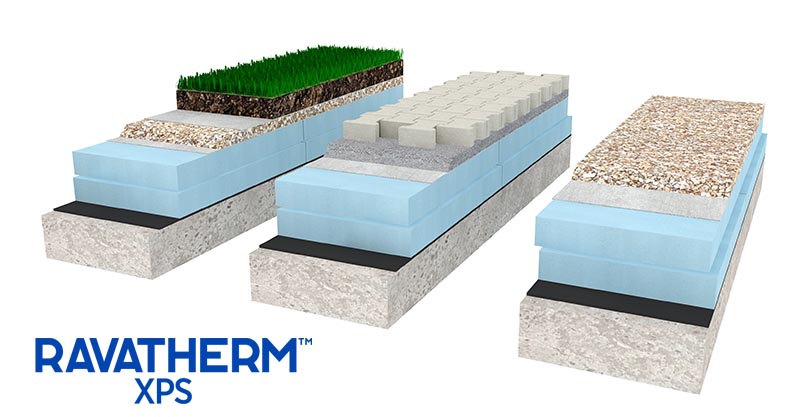
When designing buildings, it is becoming increasingly important to use architectural tools to return as much of the green space occupied by the building as possible. The creation of green roofs and roof gardens is of particular importance in urban environments. Green roofs can provide expanded living space, contribute to air cleanliness, and their rainwater retention and water retention effect is also significant. The green roof has an indirect beneficial effect by sparing the rainwater and sewage drainage network. The inverted layer system is a well-proven, long-lasting structural solution for both extensive and intensive green roofs. The main advantage of the system is the thermal and mechanical protection of the insulation against rainwater by the thermal insulation boards.
RAVATHERM XPS in a green roof
Green roof solutions are gaining more and more popularity, as they not only have aesthetic benefits, but also create new living spaces and improve air quality. In addition, they also have an extra physics advantage: in summer they act as a heat shield against the huge heat-storing concrete surfaces.
The blue RAVATHERM XPS 300 SL thermal insulation boards are resistant to moisture and permanent loads due to their closed cell structure, making them ideal for a green roof with an inverted layer order.
It is important to note that the rainwater insulation of green roofs should be made of root-resistant (e.g. FLL-certified) material, otherwise a layer for this purpose must be installed. When designing the slope and drainage, it is important that the RAVATHERM XPS sheets are not permanently submerged in water. In intensive roof gardens, the use of a drainage layer that is constantly flooded with water should be avoided.
Extensive roofs
As a top layer, primarily soil mixtures with high water retention capacity or special, so-called mineral substrate, which also plays the role of a drainage layer, can be used. In the latter case, a separate seepage layer is not necessary, min. 60-100 mm layer thickness is recommended. The network of roots of the continuous vegetation also ensures stability against wind load, additional loading is required along the roof edges and connecting surfaces, or. gravel-loaded strips and surfaces must be created along the edges and in the vicinity of the drains in accordance with the Roof Insulation Guidelines.
Intensive roofs
It is advisable to determine the type and composition of the topsoil of intensive roof gardens, as well as the plant culture to be planted, with the involvement of a garden design professional. Wind protection of larger plants to be planted must be provided by professional mooring and support, depending on the thickness of the topsoil.
Additional elements of the inverted layer structure:
Thermal insulation
The waterproofing is covered with RAVATHERM XPS 300 SL extruded polystyrene foam insulation, up to a thickness of 28 cm. One of the many advantages of the inverted layer design is that it protects the waterproofing from temperature fluctuations, UV radiation, and mechanical effects during construction, which means that the lifespan of the installed waterproofing can be several times longer than that of its counterparts exposed to the elements.
Finally, it is also worth considering that in the event of a change of function – even a floor extension – it is easy to dismantle and recycle the material. This can also be beneficial during repairs.
Waterproofing:
On a flat roof with a reversed layer order, the rainwater insulation should preferably be made of SBS modified bitumen thick sheet. First, a cold bitumen glaze coating should be applied to the surface, then 2 layers of flame-melted bitumen thick sheet rainwater insulation should be applied over the entire surface.
Slope:
In the case of a reverse layer design, the proper slope of the roof surface can be ensured in several ways. The most common solution is to use a separate on-site lightweight concrete structural layer, but the slab itself can also be designed with a slope.
The load-bearing slab:
The load-bearing structural part of flat roofs is most often formed by a monolithic reinforced concrete slab, statically dimensioned based on knowledge of the loads of the given flat roof.
The type and layer thickness of the slab structure always depend on the planned layer structure of the flat roof, the expected loads, and the geometry of the roof surface. Their geometry can be freely designed to suit the given needs, they have favorable vapor barrier properties, significant load-bearing capacity, and form a uniform, homogeneous surface.
Another advantage of the reverse layer design is that the layers installed after the rainwater insulation has been completed (extruded polystyrene foam thermal insulation, protective-separating geotextile, load-bearing and walking layers) are not sensitive to moisture, roof insulation work can be scheduled much more freely, and the construction schedule can be maintained even in adverse weather conditions.
When designing a green roof, it is important to note that the waterproofing can also be easily damaged during the accompanying garden work (shoveling, hoeing), so in this case, the reverse layer order is the most obvious solution. The green roof is also an environmentally friendly solution in many ways. Vegetation helps relieve the burden on the sewer system, binds some of the dust, reduces summer warming and, if it is large enough, has a positive effect on the city’s microclimate.
The vapor-permeable separating layer laid on the thermal insulation prevents fine particles from washing into the drain layer or between the thermal insulation boards, and also provides mechanical protection for the surface of the boards.

Leave a Reply