

RAVATHERM XPS 300 WB is a closed-cell, roughened, plaster-based, closed-cell polystyrene foam thermal insulation material. Its typical application is in those parts of buildings where, in addition to effective thermal insulation, high mechanical resistance and thermal insulation capacity preserved even in humid environments are required.
Due to its advantageous properties and excellent technical performance, the roughened surface RAVATHERM XPS 300 WB thermal insulation is most often designed and installed on building plinths (also below ground level), at terrace and balcony connections, as well as so-called remaining formwork, for additional/pre-insulation purposes, in slabs, cornices, and on the facade surfaces of column frames.
Preparation
Before installing thermal insulation, several factors must be considered to ensure that the final structure delivers the expected performance.
The following should be considered during design:
– the conditions of the installation site during construction and after completion
– the condition of the substrate (if it is not suitable, it must be repaired)
– the shape of the base of the carrier (+/- 0.5 cm / in case of deviation from the plane within 2 m, the technical solution for the addition must be decided! 1. the thermal insulation will be wavy 2. the unevenness must be leveled 3. the installation of thermal insulation boards with varying thicknesses per cm, because the thickness of the adhesive must not exceed 1 cm!)
– the behavior and performance data expected from the product.
A distinction must also be made between retrofitting an existing building and applying it to a new building. Existing building foundations often lack waterproofing, while new building foundations are usually exposed to construction moisture.
Installation of RAVATHERM XPS 300 WB thermal insulation on building plinths
Start
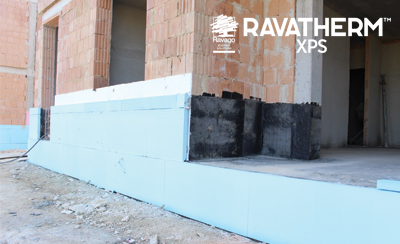
In all cases, the thermal insulation must be started in such a way that the lower edge of the plate is protected, which can be done with a metal starting profile or by so-called under-netting, when the surface reinforcing glass mesh must first be glued to the supporting base, e.g. a wall (min. 10 cm wide), then the thermal insulation is placed on top and the embedded glass mesh must be folded up and turned over to the outer side of the thermal insulation, to the facade, so that the surface can be created as a continuous (min. 10 cm overlapped) design.
If the baseboard thermal insulation starts from the sidewalk, the terrain next to the building, or the terrace connection, then the glass mesh strip must be embedded in the system adhesive on the wall, on the supporting base surface, up to a height of at least 10 cm. At least 30 cm, or up to the floor level, it is necessary to use RAVATHERM XPS 300 WB closed-cell thermal insulation board, which must be installed with regular edge + point bonding so that the mesh starting from the bottom is also embedded on the lower edge of the board.
If the baseboard thermal insulation starts below the pavement or ground level, the underlayment must still be carried out. In this case, only closed-cell polystyrene foam thermal insulation boards may be installed up to a minimum of +30 cm above the final pavement or ground level. The top plaster of the properly cured baseboard thermal insulation must reach at least 10 cm below the final pavement or ground level!
Gluing
Bonding to absorbent surfaces can be done with the adhesive specified in THR (Total Thermal Insulation System), but additional mechanical fastening – doweling – is always mandatory! On non-absorbent substrates (bitumen sheet, coated insulation, building board) with PUR adhesive foam or bitumen emulsion adhesive patch – in the case of waterproofing, without additional mechanical fastening.
Gluing should generally be done using the edge + point method and the spread adhesive should cover at least 40% of the thermal insulation board.
In the case of thermal insulation in two layers, the edge + point method is recommended for gluing the bottom layer, while the second layer, which is created by shifting the joint gaps, should be glued with PUR adhesive foam as described above.
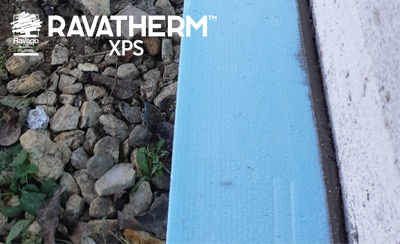
In the case of covered plinth thermal insulation, doweling should be done through the reinforcing mesh crust, always with steel hammer-in nails (or screws). Recommended number of dowels depending on the weight of the covering: ≤ 15 kg/m2 3 pcs, 15-40 kg/m2 4-8 pcs (it is recommended to take into account a maximum vertical covering load of 8 kg per dowel rod).
For covering weights up to 15 kg/m2, it is sufficient to embed one layer of glass mesh regularly and then dowel through it. For covering weights between 15 and 40 kg/m2, two layers of glass mesh doweled through the first layer, or metal mesh, and above this, in all cases, embedding metal mesh and doweling through the mesh is required.
Placement of additional mechanical fastening
When doweling the plinth thermal insulation solution, the same method as the mechanical fastening of the THR designed for the building must be used; generally, 2 dowels per board are recommended.
In addition to providing a final attachment, doweling also absorbs the stresses resulting from thermal movements caused by temperature fluctuations until the adhesive has sufficiently hardened.
In the case of a waterproofed plinth surface, always follow the designer’s instructions!
We continue our article from here with the lessons of building renovation…
Leave a Reply