

In the past, heat loss caused by rainwater was solved by oversizing the thermal insulation when designing inverted flat roofs. Today, the solution is water diversion foil.
Basic principles of the inverted roof
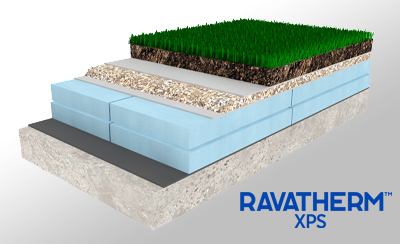
In the inverted layer-order flat roof, the waterproofing layer is placed directly on the load-bearing structure or on the slope layer. Due to this advantageous position, the waterproofing is protected from mechanical effects by the thermal insulation layer above it, and no additional vapor barrier foil is required.
In the inverted layer-order flat roof, the waterproofing layer is placed directly on the load-bearing structure or on the slope layer. Due to this advantageous position, the waterproofing is protected from mechanical effects by the thermal insulation layer above it, and no additional vapor barrier foil is required.
In addition to its good thermal insulation properties, it is equally important for the extruded polystyrene foam insulation installed in a flat roof to fully meet the strength and water absorption requirements of the XPS application standard. MSZ 7574 requires not only adequate compressive strength for inverted roofs, but also a minimum permanent compressive strength (90 kPa/m2), resistance to thawing and freezing cycles, and compliance with water immersion and diffusion water absorption values.
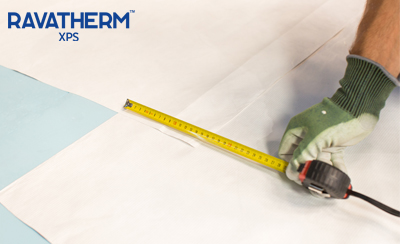
An important element of an inverted flat roof is the water flow reducing layer (WFRL), which is placed on top of the thermal insulation layer and is generally secured with gravel.
How the water flow reducing layer works
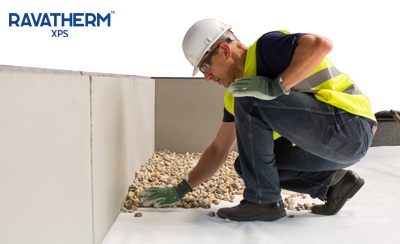
The water diversion foil plays an important role in the operation of the inverted flat roof, which should be laid loosely on the upper plane of the thermal insulation layer, with an overlap of 15 cm, and it is advisable to fold it up 5-10 cm along the attic edges. Its purpose is to drain most of the sudden large amount of precipitation on the upper plane of the XPS thermal insulation, so that a minimum part of it reaches the plane of the waterproofing. Thanks to this, it prevents cold rainwater flowing along the reinforced concrete slab from drawing heat from the interior space, which would generate heat loss.
ETAG 031 (ETAG – European Technical Approval Guidelines) for water diversion foils, a guideline for the European Technical Approval of inverted roof insulation systems. It states that the water diversion foil is a synthetic, water-repellent, vapor-permeable, UV- and rot-resistant, non-woven membrane that prevents the passage of not only precipitation but also other construction debris.
The heat transfer coefficient and thermal performance of the inverted roof structure are greatly influenced by the lack of a water-draining foil, as the U-value calculation must take into account that the structure actually achieves the planned overall heat transfer value.
How does the water diversion foil affect the U-value of the structure?
The declared lambda refers to the thermal insulation capacity of the material and is included in the product declaration of performance (DOP). The relevant test rules are given in MSZ EN ISO 10456 (Construction materials and products – Thermal and moisture properties – Tabulated design values, procedures for determining the qualification and design thermal values). However, if the insulation is used within an inverted roof system, some corrections must be included in the calculation.
ETAG 031 Annex C outlines a test to measure the performance of a water barrier membrane, which determines the ratio of water that passes through the membrane to water that drains away. This is measured by measuring the total amount of water that is allowed to flow onto the roof (WT) during the test, and the amount that drains away at the waterproofing level (W1) compared to the amount that drains away at the membrane level (W2). This is the so-called drainage factor (f), for which a generally accepted minimum value of 2.5% should be used, even if the test result is 0%, as this layer does not provide watertightness.
The EN ISO 6946 standard specifies a value of 0.04 for the fx value, which in the worst case (for XPS boards with straight edges) means that “f” (water drainage factor) = 1 and the “x” constant is 0.04 W·m-2·K-1 based on the heat capacity of water (4190 J·kg-1·K-1), the water density (1000 kg·m-3) and the saturated flow characteristics of 0.864 mm·day-1. The test assumes thermal insulation built into a single layer and a top layer that is easily permeable by precipitation (e.g. cullet gravel).
The heat loss correction factor can be calculated as follows:
ΔUr = p ·f · x · (R1/RT)2 [W/(m2⋅K)], where:
p – average amount of precipitation during the heating season, based on local data (e.g. meteorological station) or based on local, regional or national regulations or other national documents or standards, [mm/day];
f – the proportion of rainwater falling on the roof that reaches the waterproofing layer
x – heat loss coefficient caused by rainwater flowing over the surface of the waterproofing [(⋅day)/(m2⋅K⋅mm)];
R1 – thermal conductivity resistance of the thermal insulation layer above the waterproofing layer, [m2⋅K/W];
RT – total thermal resistance of the structure before applying the correction, [m2⋅K/W].
Summary
Given the important role that the water diversion foil plays in the thermal performance of an inverted flat roof, the correct use and installation of the foil is highly recommended, as, according to the tests carried out, it reduces the heat loss caused by water flowing down the plane of the waterproofing to 0, so that the designed structure actually delivers the expected performance. The insulation guidelines and instructions issued by the ÉMSZ (Hungarian Association of Building Insulation, Roofing and Tinsmiths) provide additional guidance for contractors in order to ensure that the roof insulation elements are installed professionally. The water diversion foil does not require any further maintenance after installation and also increases the lifespan of the thermal insulation. This does not mean, of course, that the flat roof will become maintenance-free by using the water diversion foil. The usual maintenance work must of course be carried out, the drains must be cleaned and the condition of the roof must be checked regularly.
Leave a Reply