

Thermal insulation built into the floor of a large industrial building must withstand special stresses. High-strength extruded polystyrene foam thermal insulation products are advantageously used for thermal insulation of floor structures lying on the ground. Regardless of the function of the building and the construction conditions, they can be installed either below or above the floor slab.
The thermal insulation located under the floor slab is subjected to continuous, intensive stress: • usage stress (vehicles, forklift traffic, high shelves, machines, industrial equipment) • static load (loads transferred from connecting building structures) • dynamic load (starting, braking, vibration) • mechanical stress during construction.
Such installation cases are also special because the thermal insulation boards placed under the floor slab themselves have the role of load-bearing. The thermal insulation must therefore not only be moisture-resistant and have a permanently high thermal insulation value, but it must also meet a permanent load value!
Thermal insulation materials used in floor structures are subjected to increased load stresses, therefore strength characteristics are of paramount importance. Extruded polystyrene foam thermal insulation products with high compressive strength can be advantageously used for thermal insulation of floor structures lying on the ground.
Designing principles
Another advantage of extruded polystyrene foam is its flexibility, so the insulation can be adjusted to a certain degree, and the boards do not break when the floor is being ironed.
Depending on the load level and the area of application, RAVATHERM XPS 500 SL and 700 products are recommended for thermal insulation under the floor slab of floors lying on the ground.
Load bearing structure
Load-bearing floor structures with thermal insulation exposed to vehicle traffic and heavy loads can be designed taking into account the design values of the compressive strength and elastic modulus of RAVATHERM XPS thermal insulation boards.
The nominal compressive strength value stated in the technical documentation represents the resistance of the products to short-term loads during laboratory tests. For thermal insulation plastic foams, this short-term (nominal) compressive strength value is not applicable for structural calculations, but is only used for strength and comparison categorization of individual products. The compressive strength value for permanent loads shall be used to determine the load-bearing capacity of the floor structure, including the thermal insulation layer, against permanent and useful loads.
The technical documentation of the products also includes the value of the compressive strength for permanent load determined according to the EN1606 standard, taking into account a 50-year application period and a maximum compression of 2%. This means that if the permanent load value transferred to the thermal insulation boards is exceeded, the compression of RAVATHERM XPS extruded polystyrene foam boards is expected to not exceed 2% of the thickness after 50 years. For increased safety, it is advisable to use the compressive strength value for permanent load when dimensioning floor slabs exposed to intensive vehicle traffic. The steel requirement for the floor slab acting as a load-bearing structure above the thermal insulation should be designed with the involvement of a structural engineer; the dimensioning is usually carried out according to the calculation methods for flexible reinforced concrete slabs.
Implementation
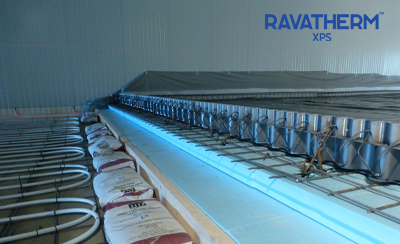
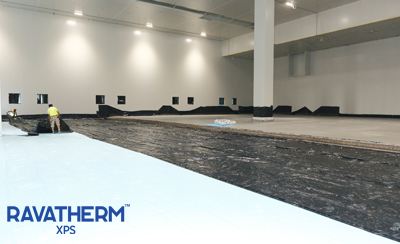
RAVATHERM XPS thermal insulation boards should be laid in offset joints directly on compacted gravel or thin concrete, with sand levelling if necessary. The thermal insulation boards can be laid quickly and easily in any weather conditions. The boards can be cut to size with a hand or electric saw, and the cut surfaces can be fitted precisely. Due to their high strength, the spacers of the sheet reinforcement do not press into the thermal insulation boards, thus ensuring the necessary concrete cover. If the thermal insulation boards are installed above the insulation against soil moisture and groundwater, they also act as a mechanical protective layer during construction, which is particularly advantageous when installing steel. RAVATHERM XPS boards are resistant to compressive and bending loads that may occur during transport to the construction site. Therefore, the risk of damage to the boards is significantly reduced. The combination of the low weight and larger size of the thermal insulation boards facilitates their economical transportation and handling.
Leave a Reply