

In the first part of our article series, we addressed the feasibility of high-thickness thermal insulation, and in this part we will show how to apply high-thickness closed-cell polystyrene foam thermal insulation below ground level.
XPS on basement walls, under buildings and in floors
We generally consider the thermal protection of the space boundaries of our buildings to be justified for the parts of the building above ground level, including basement ceilings and/or floors lying on the ground, as well as building plinths. However, nowadays, more and more often, interior spaces are located below ground level, the intended usability and economical operation of which justify thermal insulation. The current energy regulations cover buildings (building parts) containing rooms intended for long-term occupancy, and the design of those in which energy is used to ensure the air condition prescribed in the law or in the technological instructions. This is basically an energy consideration, but in such cases, the consideration of comfort and structural protection/moisture technical conditions is also a design aspect.
What “special” stresses arise below ground level?
- constant and/or increased moisture load (soil vapor, soil moisture, groundwater, strata water)
- lateral pressure, which varies with the depth below ground level and the structure and internal friction properties of the surrounding soil. (knowledge of geotechnical/soil mechanics conditions is required)
- under a building the exceptionally high, permanent compressive load
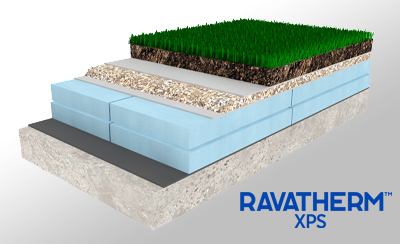
In terms of their compressive strength, RAVATHERM XPS thermal insulation can be used for a stress of at least 130 kPa under permanent load (with 2% compression). This corresponds to a uniformly distributed load of approx. 13 tons per square meter, or a ground pressure that does not exceed this (depending on soil structure and water pressure). RAVATHERM XPS products retain their thermal insulation capacity even without waterproofing, because thanks to their material structure, their water absorption capacity is so low that it does not significantly change their thermal insulation capacity. The solution that protects waterproofing is becoming more and more popular, where the so-called “protective wall” can also be moisture-resistant XPS thermal insulation. However, in these cases, the built-in “protection” not only ensures mechanical protection, but also provides adequate thermal insulation for the basement level. RAVATHERM XPS thermal insulation boards do not provide waterproofing on their own, this must be ensured by insulating against groundwater, soil moisture, and soil vapor according to the dryness requirements of the space behind the insulated wall.
Mechanical fastening is not permitted on waterproofed wall surfaces in contact with the ground (to protect the continuity of the waterproofing). Above ground level, it is advisable to ensure bonding with a -consciously designed- dowel fastening supplement.
Special care must be taken when backfilling the soil next to insulated basement walls. It is advisable to install a highly permeable fill next to the XPS boards (fine-grained, incomplete or single-grained gravel, single-grained crushed stone). Backfilling should be done in layers and with careful compaction, because this way the sliding force acting on the surface from the natural settlement of the soil can be avoided. The same rules must be followed in the case of leaky construction. In the case of irregular backfilling, the settling soil will move, damage, and destroy the thermal insulation.
LET’S CONTINUE!
Leave a Reply