

In order to meet the energy requirements valid from January 1, 2018, a minimum thermal insulation thickness of 12 cm is required for floors and building foundations, and a minimum thickness of 20 cm for inverted roofs.
Is it worth using thicker thermal insulation in these parts of the building?
Of course! It is necessary to prepare now for the further strictures that are expected from 2021, although the minimum heat transfer requirements will not change for the time being, however, the specific heat loss factors (qm – W/m2K) will become stricter depending on the A/V (cooling surface/heated volume) characteristic of the building, so the thermal insulation thicknesses may continue to increase.
Thick thermal insulation in floors
In the case of low-energy buildings, thermal insulation under the entire building is not an exaggeration, especially if it is made with a slab foundation. Although the downward heat flows generally do not exceed 10-15% of the building as a whole, the ideal continuous thermal protective envelope can only be achieved with this solution.
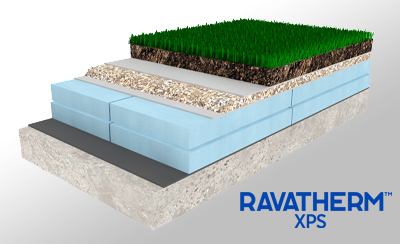
RAVATHERM XPS 300 SL materials are the most commonly used types of thermal insulation for floors lying on the ground. During the planning, the thickness of the thermal insulation layer, the floor area of the room to be thermally insulated, the thickness of the covering socket, its type (iron or non-iron), the amount and type of the useful loads (dynamic effect, sliding stress) must be examined.
In the case of new construction, even greater thicknesses of XPS thermal insulation can be safely installed in the floors.
During building renovations and conversions, there is usually little space for thermal insulation material, so it is particularly beneficial to design high-efficiency XPS, which can be used to save centimeters.
What thickness of thermal insulation should I choose?
With cold floors, there is an increased need for thermal insulation, both from the point of view of moisture protection (condensation on the floor) and thermal sensation. If underfloor heating is being installed, the best possible thermal insulation is required to reduce heat loss. In the case of underfloor heating, care must be taken to determine whether it is a modern, reliably controlled and professionally designed and executed heating system, or whether we are dealing with an old, traditional mixed-fuel -uncontrollable- system. Extruded polystyrene withstands a temperature of + 45oC permanently without any damage, which is usually not higher in a professionally designed underfloor heating system. However, if the heating medium is +80oC or higher – which is not typical today – (impatient building users want quick heating from a traditional mixed-fired boiler), XPS thermal insulation is not recommended.
When installing thick XPS thermal insulation (over 14 cm), it is essential to use an electric (chisel) melt-cutter suitable for on-site cutting or a suitable (dust-extracting) saw.
WE’LL CONTINUE!
Leave a Reply