

Joan Ferrer, Commercial Director UK & IRE, Ravago Building Solutions

Calculating prospective U-Values is a routine part of the building design process, so routine that you could be forgiven for not giving all that much thought to the intricacies of each and every calculation. However, the slightest of changes to certain variables can have a significant impact on the final result and mistakes made in the design stages can come back to haunt us. Nobody wants to find out that their finished building is unable of achieving its intended thermal performance, and perhaps even finding that this shortfall scuppers an attempt to attain Passivhaus certification.
So, you have sent your specification off to a selection of building product manufacturers asking for a U-Value calculation using their product – they are aware of every aspect of your buildup, meaning the only variable in their U-Value calculations should be the thermal performance of the insulation, right? Unfortunately, individuals performing calculations have a degree of latitude in some areas despite the existence of standards and best practice advice on how to product U-Value calculation, making it difficult to achieve a true like to like comparison.
The impact of ground types
Let us consider the case of ground-bearing floors – the thermal properties of the underlying ground can have a notable impact on the overall thermal performance of a buildup. It is therefore important to ensure that the U-Value calculations for competing insulation products have been compiled using the same ground type to allow you to make an informed decision. To this end, you should always provide the ground type (if known) when requesting a calculation to ensure that the resulting U-Value is most accurate.
BS EN ISO 13370:2017 states that there are three categories of ground type:
| Category | Description | Thermal Conductivity |
| 1 | clay or silt | 1.5 W/mK |
| 2 | sand or gravel | 2.0 W/mK |
| 3 | homogenous rock | 3.5 W/mK |
The standard is clear that when the ground type is unknown it should be assumed to be category 2. While there is a swathe of fantastic tools on the market to help produce U-Value calculations, some of them actually default to using category 1, so those performing the calculation need to make sure that this is changed when a prospective customer has not specified a ground type.
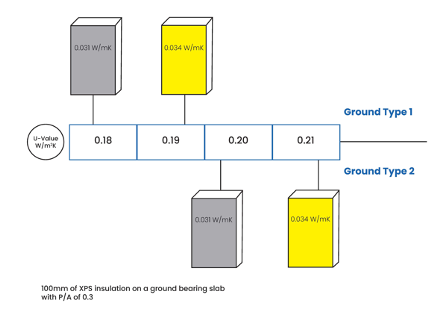
To demonstrate the importance of using a consistent ground type across calculations, let’s look at an example buildup involving 100mm of XPS insulation on a ground bearing slab with a P/A of 0.3. In this scenario, using an XPS board with thermal conductivity of 0.031 W/mK results in a U-Value of 0.20 W/m2K when calculating for ground type 2, meanwhile a board with thermal conductivity of 0.034 W/mK can achieve a U-Value of 0.19 W/m2K if we instead use ground type 1; unless you were checking for the difference in ground type you would think that the board with higher thermal conductivity was the superior solution!
What elements should be included in the calculation?
BS EN ISO 13370:2017 is also somewhat ambiguous on how to account for the thermal properties of some elements of a ground bearing floor. While it is explicit that the hardcore below a concrete slab should not be included, it states the “thermal resistance of a dense concrete slab may be neglected”, leaving it to the individual performing the calculation to decide. This decision is quite a significant one, as typically the inclusion or exclusion of the concrete slab’s thermal resistance will cause a variance of 0.01 to 0.02 W/m2K in the final U-Value.
The 2019 edition of Conventions for U-Value Calculations (BRE BR443) provides best practice advice to complement the standard. At first it is quite definitive, stating that “It is recommended for most calculations that dense floor slabs (ρ ≥ 1800 kg/m³) and floor coverings such as vinyl or carpets are not included in the calculation”, but frustratingly, it then immediately reintroduces the ambiguity of the standard by saying “but it is permissible to include them if their properties are adequately defined.” It is therefore important to check exactly what elements have been included in individual U-Value calculations before trying to compare them.
The need for a common standard
These are just a couple of examples demonstrating how difficult it can be to compare U-Value calculations when trying to specify insulation. We need to start calculating U-Values with a consistent and transparent methodology that will allow specifiers to compare the performance of different insulation products quickly and easily.
As the construction sector continue to rehabilitate its image in the wake of Grenfell, construction product manufacturers need their customers to trust technical advice about their products, regardless of any potential short term commercial advantage. It is essential that we can all trust U-Value calculations and have faith that they give us a true reflection of how a building will perform once transformed from plans into bricks and mortar. We need these figures to be accurate to save us from prospective planning and certification issues, not to mention the spectre of contractual disputes.